26 Nov 15:00
Conversations with Igor Zabel Award Grant recipients Tania Arcimovich, Octavian Esanu, and Alona Karavai, moderated by Pia Brezavšček, Jakub Gawkowski, and Vasif Kortun
Prost vstop
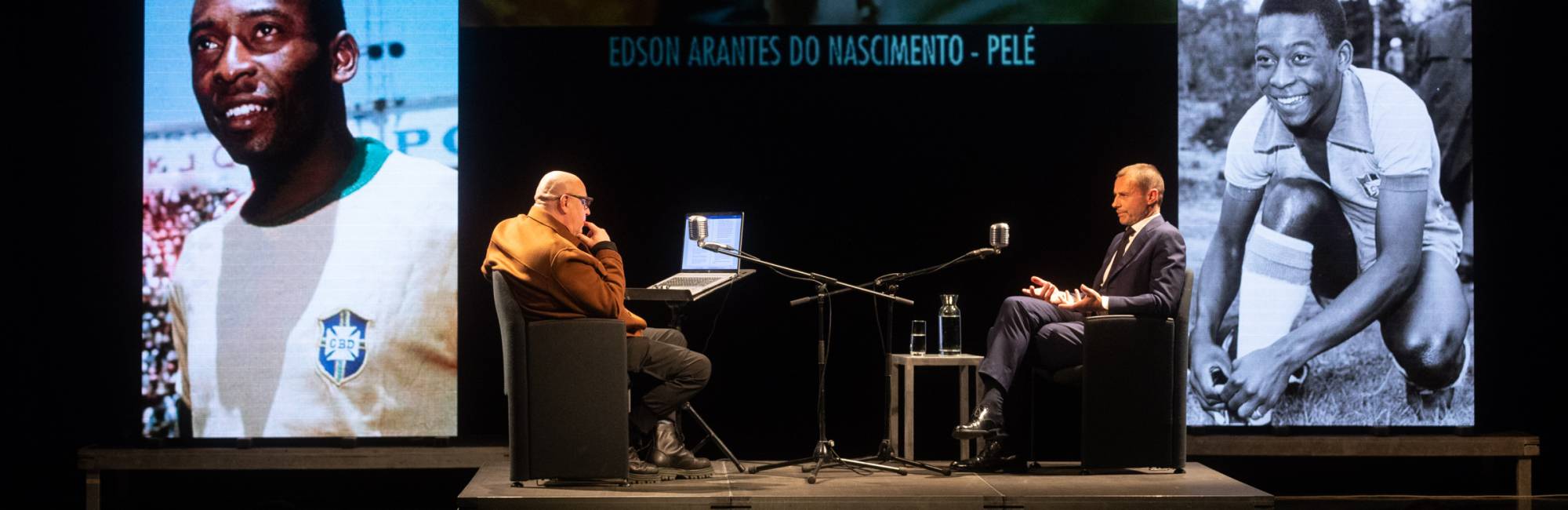
Conversation led by: Matjaž Berger
Guest: Aleksander Čeferin, president of UEFA
"An outcome known in advance, with no possibility of error and surprise, clearly leading to an inescapable result, is incompatible with the nature of play. […] The game consists of the need to find or continue at once a response, which is free within the limits set by the rules. This latitude of the player, this margin accorded to his action is essential to the game and partly explains the pleasure which it excites. This latitude also accounts for varied uses of the term 'play'…”
Les jeux et les hommes (Man, Play and Games) by Roger Caillois
The performing arts share with sports the underlying premise that they are, above all, a game – ludus – a term once associated with the vectors of play, as well as with spaces for learning and training.
Athletics has been hailed by its fans as the ‘queen of sports’; boxing has been dubbed a ‘noble art’ by the romanticised proponents of the science of strength; while the spectacular nature of football has earned it the lyrical appellation ‘the beautiful game’ (perhaps dating back to the era of Pelé’s ‘ginga’ – that uninterrupted, fluid, rhythmic movement, that swaying, back-and-forth footwork – and Brazilian football). As the legendary Slovenian sports philosopher Dr Lev Kreft explains, the term is difficult to translate because it loses its metaphorical power: “Slovenian does not make a clear distinction between ‘play’ and ‘game’; both are usually translated as igra, although ‘game’ sometimes refers to a ‘match’. Yet ‘the beautiful game’ and ‘a beautiful match’ do not mean the same thing in English.”
How, then, should we conceive of the ‘beautiful game’? As the nobility of skill or the beauty of execution? As a battle or a spectacle? As a celebration? As a contest – as agon? As honour and virtue – as arete? As a synthesis of, or a distinction between, aesthetics and purpose – between the esthetic and the goal-oriented?
Or perhaps we should approach the question through two insights developed by Lacan and Nietzsche. Lacan says: “We think we think with our brains, but personally, I think with my feet.” This ‘footballing’ statement, made on 2 December 1975 during a lecture at the Massachusetts Institute of Technology (MIT), invites us to understand thinking with one’s feet in Lacanian terms as a matter of movement and contact – contact with the real. It suggests that thought arises through an encounter with something ‘hard’, with the resistance of the real, and that the body participates in the production of meaning. ‘Feet’ can thus be understood as a metaphor for the subject’s embeddedness in the actuality of the body and of jouissance … Therefore, the beautiful game may be the Archimedean point of jouissance for the player – homo ludens – and for the spectator, who is interpellated through the player’s jouissance, thereby multiplying and perpetuating the function of spectacularity. Nietzsche, however, writes in Thus Spoke Zarathustra: “He who would learn to fly one day must first learn to stand and walk and run and climb and dance; one cannot fly into flying.” Nietzsche’s philosophical and sporting discourse – discursus, which also means ‘running to and fro’ – develops the gestus of learning to stand, walk, run, climb and dance. This process is established, dismantled, destroyed and rebuilt through testing and questioning one’s own gait and path, which, as Nietzsche suggests, is unique to each individual.
Football, the beautiful game, a game of ‘thinking with one’s feet’, with rules that are changing, technologies that are transforming it, tactics that are evolving, and strategies – varying according to formations – that constrain and define it… Where does football remain within the realm of homo ludens, and where, and how, does it become a technological representation in which players are transformed into cyborgs who no longer play the game, but rather perform a formation – for victory, for the coach, for capital, and for the capital-driven corporations that turn them into commodities for sale? Within the star system, understood as a symptomatic practice, these players represent the socio-economic laws of global post-industrial society. How, in this context, can we establish the values, virtues and identities that allow us to look beyond good and evil when addressing racism, nationalism, religious intolerance and gender equality – issues with which football has long engaged? Is sport an art form, and how should we understand the difference between the two in terms of their status in everyday life?
A soiree featuring Aleksander Čeferin, President of UEFA, the governing body of European football, will address the issues outlined above.
A committed intellectual, a leading Slovenian lawyer and a passionate athlete, Aleksander Čeferin has consistently championed the essence of football – its players and the game as an expression of ludus. In his inaugural presidential address at the 12th Extraordinary UEFA Congress in Athens on 14 September 2016, he declared: “We will promote, protect and develop football.” In April 2021, as he opposed the creation of a European Super League, he condemned “the initiative of a group of greedy and self-serving interest groups” and stressed that “football belongs to the fans” and “is not for sale”. A committed advocate of social and humanitarian causes, Čeferin was elected President of the UEFA Foundation for Children in November 2017. The charitable organisation uses football as a powerful tool to defend, protect and support vulnerable children worldwide.
Matjaž Berger
Brezplačne vstopnice.
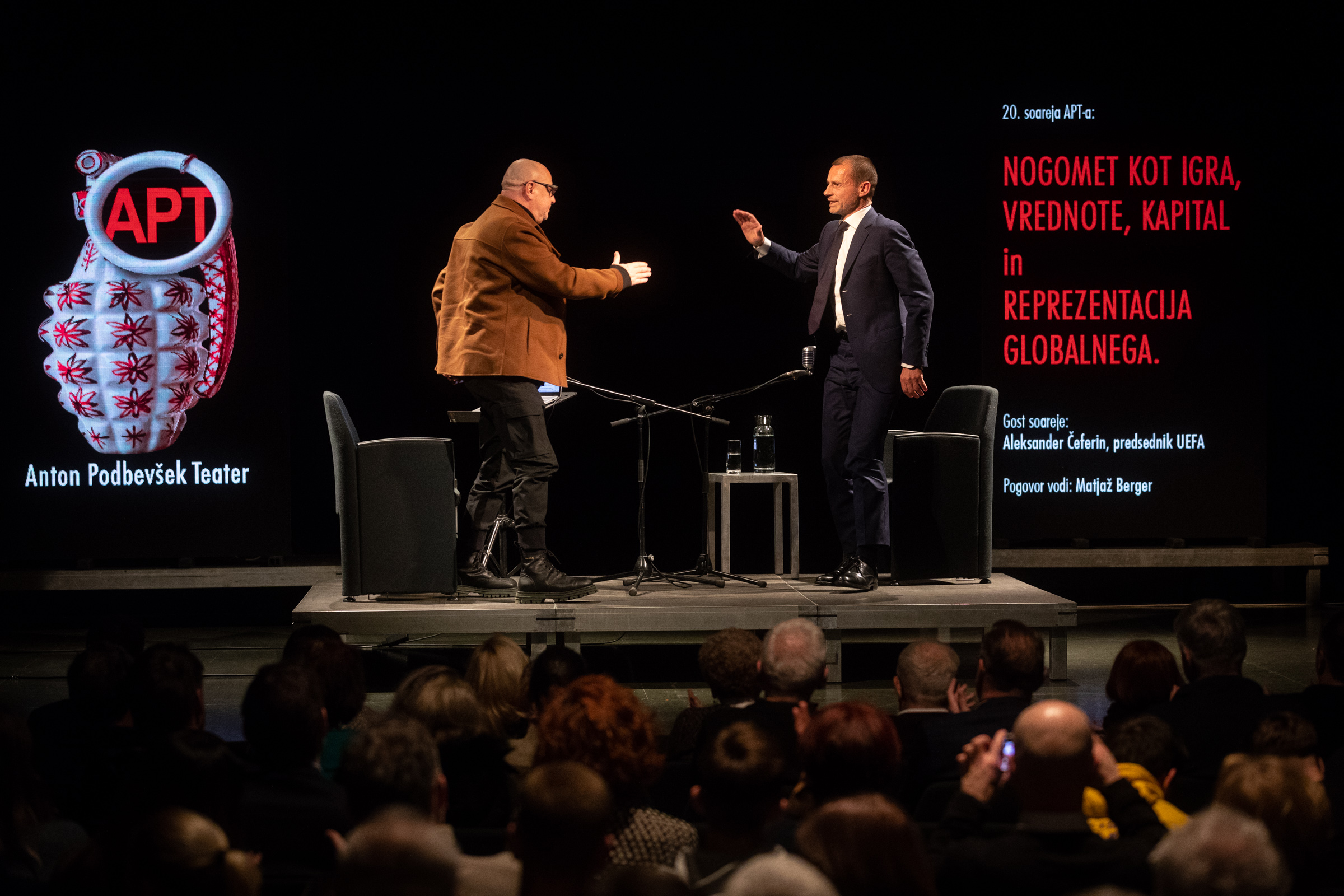
Foto Boštjan Pucelj
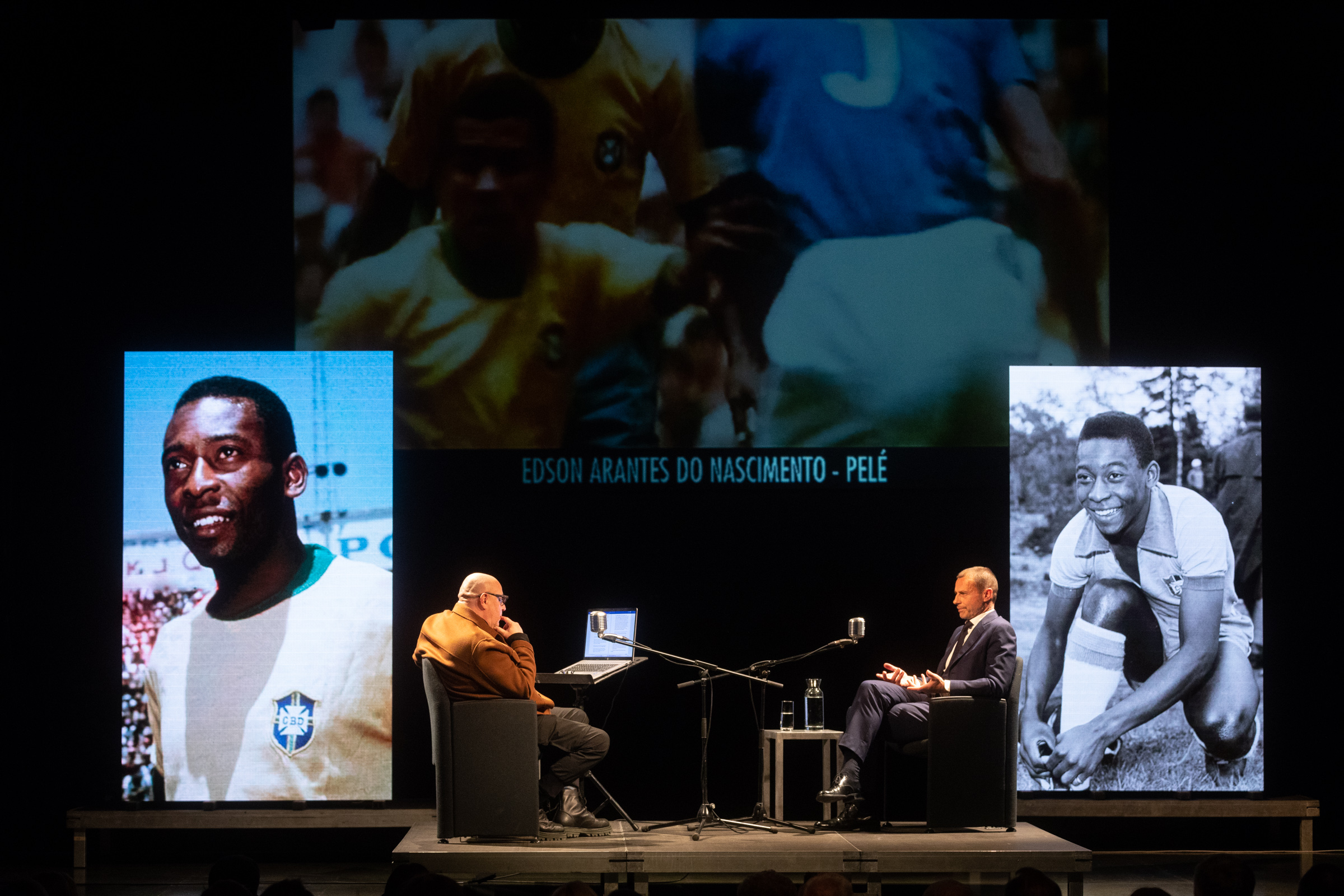
Foto Boštjan Pucelj
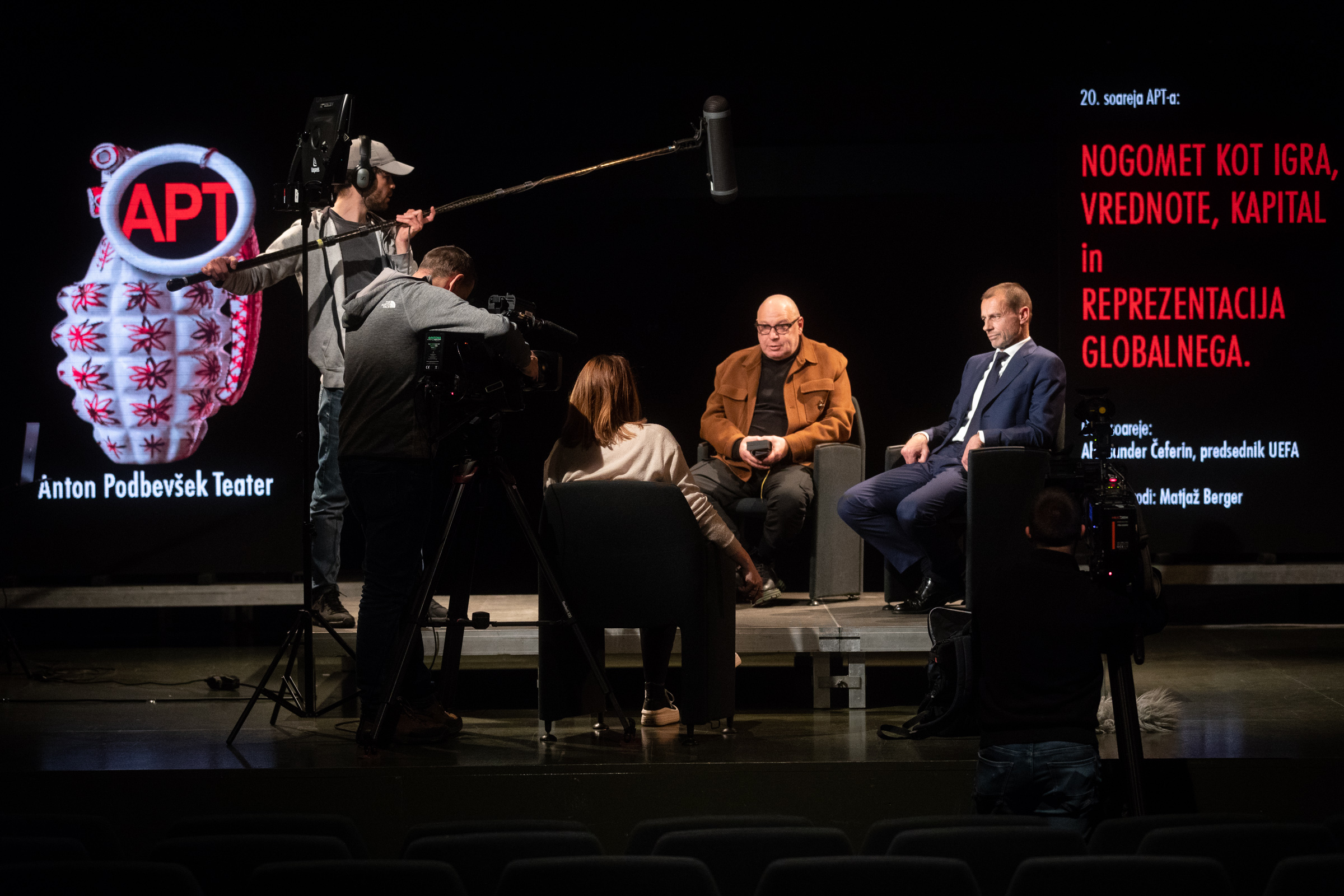
Foto Boštjan Pucelj

Conversations with Igor Zabel Award Grant recipients Tania Arcimovich, Octavian Esanu, and Alona Karavai, moderated by Pia Brezavšček, Jakub Gawkowski, and Vasif Kortun
Talks on Immigrant Literature

Founder and main co-funder of Cankarjev dom’s Arts and Culture programme

